
Meta ads can be useful, but don’t assume Meta’s reporting tells the whole story.
A client we work with spends close to six figures a month on Google and four figures on Meta – roughly one-tenth as much. Yet Meta’s reporting attributes one fifth of the total online revenue to its ads. While we’d love a marketplace to deliver 6 figure revenues from 4 figure spend, will any other reporting platform give the same story?
Google Analytics is a go-to reporting tool that most people would use as their source of truth when it comes to how well channels work on your website. Which when we check Facebook’s performance, it only shows a 5 figure revenue. For this client we typically see Google Analytics report the revenues generated from Meta Ads at 17% of the levels of revenue that had been reported in Meta reporting.
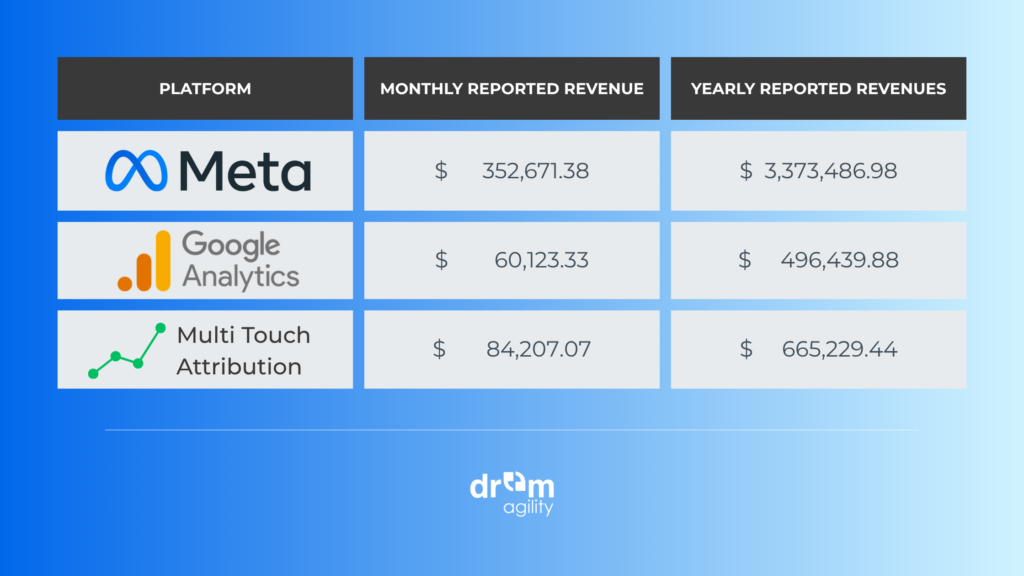
Now attribution can play a large role in how revenues get sent back to certain platforms. Thankfully Google Analytics provides us with the tools we need to cross reference this in Multi Touch Attribution.
The Attribution Paths – This section allows us to investigate users, and see what touch points they took to get to the site before their purchase. One way we use this report is to see of all the sales we received, how many had a touch point with certain channels, i.e. Facebook. Now you’d expect the Revenue now to match between the Meta Reports & Google Analytics.
When evaluating Meta’s performance through Multi-Touch Attribution (MTA) paths, even under conditions where Meta is credited with every single touchpoint it influenced, we see credited revenue rise by only 20% to 40% above baseline Google Analytics figures. This highlights a substantial, unaccounted-for gap between what Meta’s native dashboard claims and what cross-channel path data can actually substantiate.
Even with 100% touchpoint inclusion, multi-touch paths can only bridge a fraction of the gap, leaving the majority of Meta’s claimed revenue completely unsupported by verifiable path data. This underscores the extent of platform over-attribution and why top-of-funnel channels cannot be evaluated solely on native dashboard metrics.
ACTION
Before increasing spend, check that conversion tracking is configured correctly and compare results against a consistent source of truth, such as GA4 and, where possible, your CRM’s lead and sales data. Use Meta’s reporting to help manage Meta campaigns, not as the sole measure of overall performance. If sharing website events with Meta and ultimately your competitors isn’t right for your business, review whether the Pixel is needed and what alternatives fit your measurement and privacy requirements.
Are Your Ads Delivering the Results You Think They Are?
At Dream Agility, we help businesses look beyond platform-reported numbers to understand what’s really driving sales and revenue. By combining our own AI-powered technology with experienced marketing specialists, we help businesses improve tracking, reduce wasted ad spend and make smarter decisions across Google Ads, Meta and other advertising platforms.
Want a clearer picture of your advertising performance?
Get in touch with Dream Agility to see how we can help you make more of your marketing budget.